
 admin@bonzermarketeers.com
 +918799573034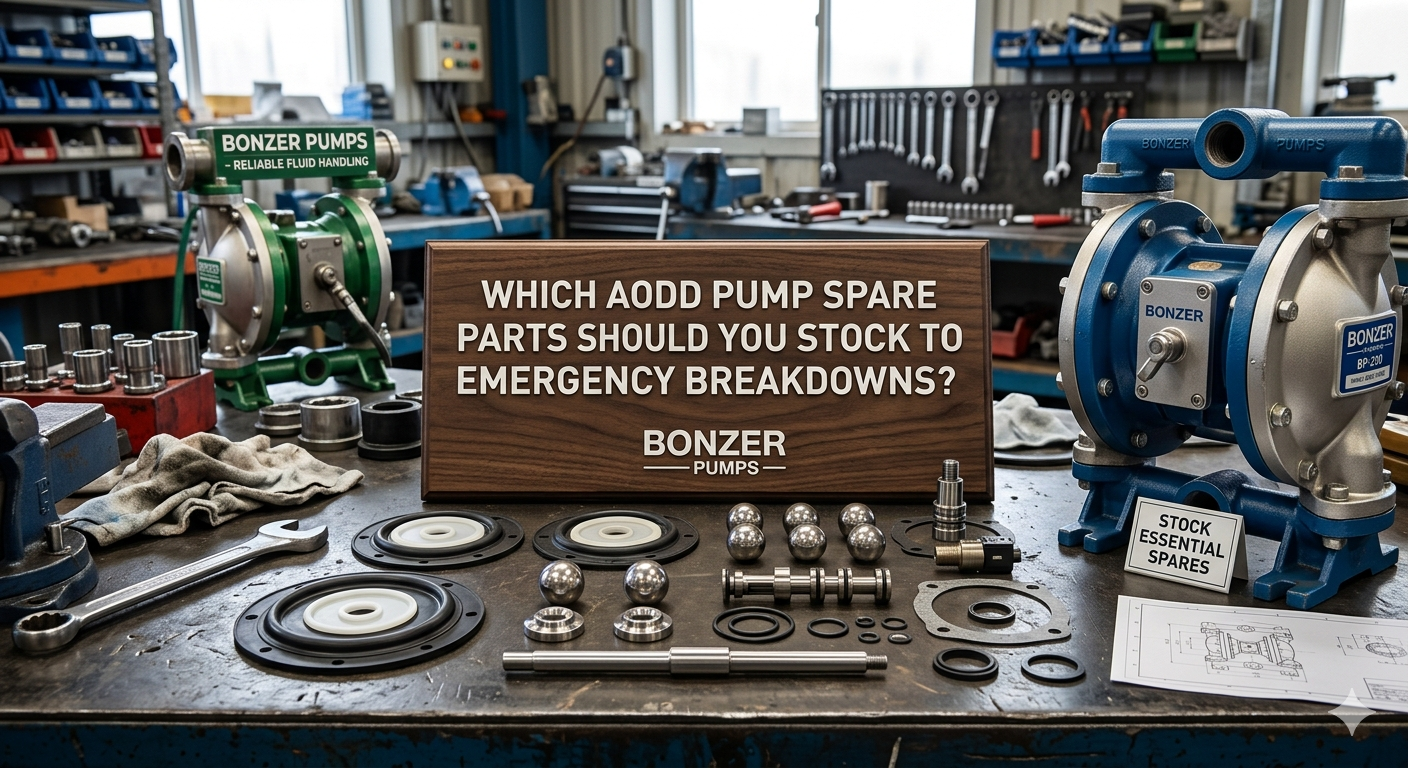
You cannot always equate the price of one single damaged component with the true cost of an AODD pump failure. Rather, the latter is usually defined by events like delayed batches, lost production hours, missed delivery commitments, and unplanned maintenance pressure across the line. This is where a meticulously planned list of critical parts is crucial. After all, only then can you avoid the costly mistake of waiting for these components to fail before placing an order.
Today’s market is shaped by unpredictable global supply chains and long lead times. So, if you still rely on reactive purchasing, a minor wear issue can soon escalate into a major production disruption. The only and most practical approach is to keep the right AODD pump spare parts in stock, especially for high-dependency operations. At least then you won’t have to worry about emergency breakdowns and having no solution in hand.
The smarter approach is to identify the genuine wear parts and the long-life hardware items. Having said that, we have broken down this distinction clearly in this guide, along with explaining how Bonzer Pumps fosters accelerated recovery with reliable, premium-grade spare parts.
The Critical Three: Essential Spares for Every Maintenance Cabinet
Diaphragms: The most common failure point
The first item making its place on the spare part list for an AODD pump is the diaphragm. It’s usually tasked with handling constant flex during every pump cycle. Over time, the repeated motion reduces the flexibility. To top it off, prolonged exposure to aggressive chemicals, temperature swings, and incorrect material selection often leads to accelerated cracking, swelling, and even rupture.
That’s why every reliable maintenance team keeps at least two full sets of Air-Operated Double Diaphragm Pump Sets ready in hand. Out of these, one remains installed within the pump while the other is stored on the shelf for immediate replacement. Bonzer Pumps brings a wide range of elastomer options, allowing users to perfectly match the diaphragm material to fluid type, duty cycle, and operating conditions.
Valve balls and seats: Maintaining the seal
Both these components have a crucial role in maintaining internal sealing and steady product movement through the pumps. The moment these parts begin to wear, the pump is likely to lose prime, deliver inconsistent flow, or suffer a visible drop in efficiency. Even a minor wear can prevent appropriate sealing, which will ultimately affect the suction performance and overall reliability.
That’s why having the valve balls and seats stocked up, especially during predictive maintenance. Only when you replace them as a matched set will help you restore the sealing surface correctly, minimize performance loss, and lower the risks of recurring issues.
Air Valve and Pilot Spool Kits
The entire air valve assembly is often considered as the brain of the AODD pump due to their controlling power over the alternating air flow driving the diaphragm movement. When the pump stalls, you can link the issue to dirty compressed air, sticky pilot action, or worn O-rings inside the air section.
Although these valves and spool kits are small in size, they are the most Critical Pump Components. Instead of wasting breakdown time troubleshooting individual seals and internal pieces one by one, you should keep the entire air-end kit ready in hand. This will speed up repairs, simplify services, and get the pump back into operation with far less downtime.
Identifying high-wear vs long-life components
Not every spare part needs to be stored on the shelf. This is where a smart stocking strategy can protect you from unnecessary maintenance expenses. The key here is to focus on high-wear items that are likely to fail regularly, while avoiding any form of unnecessary investment in major components that can last for several years to come. In a standard AODD Maintenance Kit, the next high-wear parts after diaphragms, seats, and balls are U-cup seals, O-rings, gaskets, and muffers.
These are more exposed to friction, pressure fluctuation, contamination, and routine wear. On the contrary, manifolds, center blocks, and outer pistons are usually long-lasting components and do not need to be stocked up unless the pump handles extremely abrasive fluids. If you are investing in the AODD pump part 50 series, fasteners should also meet specific high-tension requirements to ensure appropriate sealing and safe assembly.
The Proactive Strategy: Why Full Repair Kits Are Better Than Single Parts
Eliminating the weakest link syndrome
Sometimes, replacing a single failed diaphragm seems economical. However, the next breakdown risk stems from this only. After all, the remaining older diaphragms have already gone through the same pressure load, flexing, and chemical exposure, which is why they are very close to failure. That’s why it’s better if you use a complete AODD maintenance kit. Here’s why!
Replacing both diaphragms at the same time will reduce the risk of the second one failing immediately.
Related seals, O-rings, and gaskets are already at their limit, which, if not replaced, will fail.
The full-kit replacement will reduce the chances of staggered failures that will trigger repeat shutdowns.
Installing the complete kit will restore the full wear system together, not just a single damaged component.
Simplifying Inventory with Bonzer Maintenance Kits
Controlling the inventory will become much easier when you stop managing multiple separate part numbers for routine repair work. This is where Bonzer kits come into play, simplifying this by combining the required wear components into a ready-to-use package. By doing so, not only will your service teams deliver higher efficiency, but you can also maintain a stronger pump downtime prevention cycle during urgent maintenance situations.
Storage tips: How to keep your spares in peak condition
Even the right spare part can fail early if they are stored in poor conditions. Only by implementing appropriate storage ideas can you protect performance, extend shelf life, and ensure spares are ready when needed. So, here’s what you should do.
Keep the elastomer and rubber parts away from direct sunlight and extreme heat to prevent cracking, hardening, or dry rot.
Track the storage age of PTFE and rubber parts separately, as the latter tends to age faster.
Leverage batch tags or data labels to support proper stock rotation.
Label the shelves clearly by pump size, such as spares for 50mm/2-inch AODD, to speed up identification during immediate repairs.
Conclusion: Don’t let a $50 part stop a $50,000 production line
Stocking diaphragms, valve balls and seats, and air valve kits beforehand will help a lot in preventing costly pump breakdowns and operational shutdowns. Bonzer Pumps delivers the right balance of immediate availability and durability through their AODD pump spare parts.
FAQs
1. What is the shelf life of AODD pump diaphragms?
The shelf life of AODD pump diaphragms is about 3-5 years, depending on material, storage conditions, and manufacturer guidelines.
2. How do I know if I need a wet-side or air-side kit?
Wet-side will handle fluid wear, while the air-side kit will fix stalling, shifting, or valve issues.
3. Should I stock spare manifolds?
Manifolds are long-lasting components, which is why you may not stock them unless the pump handles abrasive fluids or corrosive applications.
4. Are Bonzer spare parts compatible with other major AODD brands?
Yes, Bonzer spare parts are designed for high compatibility with major AODD brands.
5. Can I mix different brands of AODD pump spare parts?
Although it is risky, mismatched tolerances will help reduce sealing, fit, and reliability.
6. What is the most common cause of diaphragm failure in 2-inch pumps?
Wrong elastomer selection, repeated flexing, and chemical attacks are the most common causes of diaphragm failure in 2-inch pumps.
7. Is it cheaper to repair an AODD pump or replace the whole unit?
Repairing the AODD pump is much more cost-effective compared to replacing the whole unit.
8. Should I replace the valve seats every time I replace the valve balls?
Yes, replacing both the valve seats and balls together will ensure proper sealing and better pump performance.
9. How many spare diaphragms should I keep in my critical spares inventory?
It’s better to keep two sets of diaphragms, one installed and one ready on the shelf to be used during emergency maintenance.