
 admin@bonzermarketeers.com
 +918799573034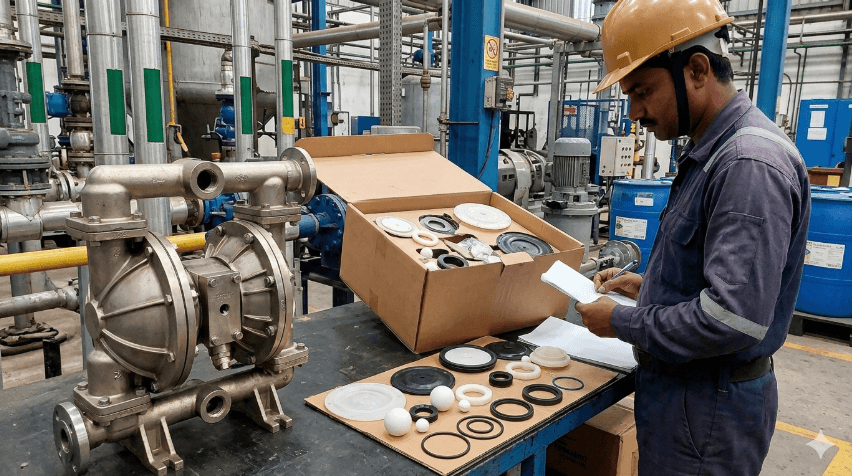
A diaphragm suddenly ruptures mid-shift. Results? Slow production. This is not unusual, but many maintenance engineers face a similar situation. But during this, one common question comes to mind: Do I need to order a full AODD pump repair kit or just replace the failed part?
This is a common dilemma across chemical, pharma, and paint plants, where uptime is critical. While individual parts may seem like the faster or cheaper option, the real decision requires more knowledge. This guide explains which option can actually help you in the long run.
What Is an AODD Pump Repair Kit? (And What Does It Actually Include?)
An AODD pump repair kit is a pre-packaged set of essential wear components. It helps restore a pump’s life and working capability to its optimal condition. These kits are also model and brand-specific. So, purchase it considering the overall compatibility.
What a Typical Pump Wet Side Repair Kit Contains
A typical pump wet side repair kit contains multiple kits that include -
Diaphragms (pair): The most critical component separating fluid from the air side
Check balls (4): Regulate fluid flow direction
Valve seats (4): Ensure proper sealing with the balls
Gaskets: Prevent leaks at joints
O-rings: Seal multiple pressure points
This configuration is referred to as an excellent pump wet side repair kit, focusing on superior and additional fluid-handling components.
What an Air-Side Kit Contains
Air valve components include - spool, pilot valve, and sliding mechanisms
Air gaskets and dynamic O-rings
In some cases, a complete air distribution assembly is necessary
Complete Kit vs Partial Kit
Complete kit: This includes both wet-side and air-side components
Partial kit: It strongly focuses on either the wet-side or the air-side for targeted repairs
What Are Individual AODD Spare Parts?
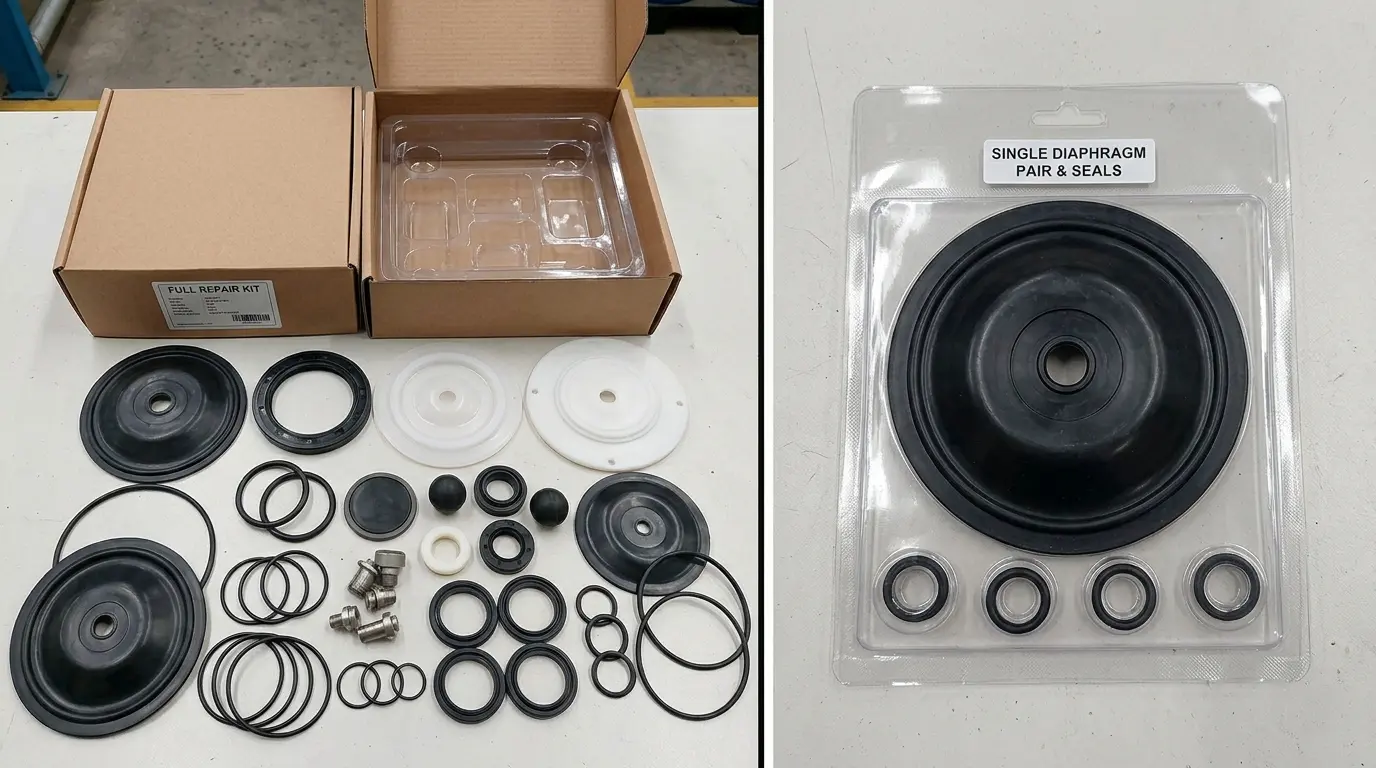
Individual spares usually refer to purchasing only the failed component rather than opting for a full set. These AODD pump spare parts should be ordered once the issue has been identified.
Some examples include:
Only the diaphragms need replacement
Check balls or only the valve seats
Need to change the O-rings or gasket sets
When Teams Typically Order Individual Parts
There are certain cases when teams can order individual parts, such as -
Emergency breakdowns: Immediate restart required to prevent pump operation breakdown, especially when you need the pump working again within 2 hours
Budget limitations: If you want to avoid higher upfront costs due to budget
New pumps: Most of the parts still have a greater usable life and the pump is in new condition
Known root cause: Only one component is affected and you know which part needs replacement
However, in such cases, even a diaphragm pump repair kit may feel excessive if only one part has failed.
Full Repair Kit Advantages and Limitations
Choosing a full repair kit simplifies overall maintenance by replacing all critical wear parts at once. But on the other hand, it also involves higher upfront costs and may not suit urgent, single-component failures.
Advantages of Using a Full Repair Kit
Perfect compatibility: All parts are perfectly matched for fit and material
Simplified procurement: One order instead of opting for multiple SKUs
Best for planned shutdowns: Ideal for proper and scheduled maintenance
Reduced failure risk: Eliminates the chances of weak leftover components
Faster reassembly: No need for any kind of additional adjustments or substitutions
Inventory efficiency: These types of kits are much easier to manage with fewer SKUs. For example, you can easily buy 5 to 6 full kits for different pump models rather than buying individual parts
A full kit can also strongly support better AODD pump preventive maintenance by ensuring all wear components are in good condition and work together.
Limitations of Using a Full Repair Kit
Higher upfront cost: Some parts may not be immediately needed; hence, there are certain limitations to using a full repair kit
Not ideal for urgent fixes: Delivery time can delay the restart of the pump
Fit risks with generic kits: Always confirm the overall model compatibility
Individual Spares Advantages and Limitations
Choosing the correct individual spare parts enables targeted, cost-effective repairs by replacing only the failed components. However, this approach can also increase the risk of repeat failures and requires careful selection. Below are both the advantages and limitations that you need to keep in mind.
Advantages of Individual Spare Parts
Lower immediate cost: Pay only for what is required
Faster emergency repair: This is necessary if parts are or can be locally stocked
Targeted replacement: Ideal when the failure cause is properly identified
Best for newer pumps: No need for a full overhaul or replacement if the pump i running for the last 3 to 4 months
Material flexibility: Upgrade specific components of the pump only
Limitations of Individual Spares
Higher risk of repeat failure: Old components remain in proper use
Complex sourcing: Multiple vendors and actual part numbers can make the whole thing complex, particularly when you collect parts from 5 to 6 different vendors.
Compatibility issues: Mixing suppliers can, most of the time, cause serious fit problems; for example, an O-ring that is 0.5mm off can cause leaks.
Not suitable for aging pumps: Multiple components may already be worn if a pump has been running for 3+ years. Not ideal in this case.
How to Decide: A Practical Decision Framework
Whether you should buy an AODD pump maintenance kit or only the spare part, you should make the decision practically, not based on a rigid rulebook. The right choice can actually help you make faster decisions on-site.
Choose a Full Repair Kit When:
The pump has been running for almost 12+ months without any kind of overhaul
You are planning a perfect and scheduled shutdown
Multiple components show wear simultaneously
You need to manage multiple pumps and want inventory simplicity
The fluid is aggressive, for example, abrasive, corrosive, and high temperature
You want to reset the pump’s full lifecycle and want to start it again like a new one
Choose Individual Spares When:
It’s a sudden emergency breakdown
The pump is relatively new, and it is under 6 months old
The root cause of failure is clearly identified
Budget is temporarily constrained
Other components are still in good condition, and only a little bit of change can solve it
The Hybrid Approach (Best Practice)
Keep one AODD pump maintenance kit in stock per critical pump
Use the correct and individual spares for quick emergency fixes
Plan full overhauls when you know the timing of scheduled maintenance
This type of balanced approach is excellent and also reduces downtime while controlling additional costs.
The Hidden Cost of Doing a Partial Repair
Many maintenance teams often face a hidden cost. When they focus only on part cost, they are actually ignoring the overall cost of failure. Consider this scenario: only the diaphragm is replaced. The pump starts running fine initially. But, suddenly, again, after three weeks, an old O-ring fails. It stops the whole production once again.
What a Repeat Failure Actually Costs
Double labor effort: Two teardown cycles instead of one
Production downtime: Multiple stoppages
Contamination risk: Fluid leakage into air systems
Emergency sourcing cost: Higher pricing for urgent orders
In reality, a partial repair often significantly increases total operational cost.
How to Build a Smart AODD Spare Parts Inventory
When developing a smart AODD spare parts inventory, ensure you are fully prepared for both planned maintenance and unexpected breakdowns. You also need to start the process by stocking the necessary AODD pump spare parts based on pump criticality, wear patterns, and the overall application needs. Hence, you can also successfully reduce downtime and control costs while improving overall reliability.
Step 1: Identify Critical Pumps
Focus on the pumps where failure most of the time leads to:
Immediate production loss
Safety or compliance risks
For these, always keep at least one full kit on hand.
Step 2: Understand Wear Patterns
High wear: Diaphragms and the check balls
Moderate wear: Valve seats and the O-rings
Lower wear: Air valve components, which play a critical role.
Stock high-wear items more frequently.
Step 3: Match Material to Fluid
Incorrect material selection often leads to premature failure.
PTFE: This is ideal for strong chemical resistance
EPDM: Extremely suitable for water-based fluids
FKM (Viton): Perfect for all the high-temperature applications
Santoprene/Buna-N: Ideal for general industrial use
Correct material selection improves overall durability while reducing the chances of maintenance.
Full Repair Kit vs Individual Spares – Quick Comparison
Below is an ideal and quick comparison table of a full repair kit vs individual spares that might give a clear idea of making the right choice.
Factor | Full Repair Kit | Individual Spares |
Upfront Cost | Higher | Lower |
Best For | Planned Maintenance | Emergency Repair |
Risk of Repeat Failure | Low | High |
Inventory Simplicity | High | Low |
Emergency Use | Moderate | High |
Suitable Pump Age | Older Pumps | Newer Pumps |
Material Matching | Easy | Requires Attention |
Frequently Asked Questions
Q1. What is included in an AODD pump full repair kit?
When you are looking for an AODD pump full repair kit, this includes diaphragms, balls, seats, gaskets, and O-rings, along with the air-side components. However, these depend on the type of kit you are buying.
Q2. How often should I replace AODD pump spares?
You should replace the AODD pump spares every 6–12 months. However, the results depend on the usage, fluid type, and operating conditions.
Q3. Can I use individual spares from another brand?
You should not do it because of the potential compatibility issues and the sealing issues.
Q4. Is a full repair kit more cost-effective?
Yes, a full repair kit is more cost-effective, especially when you consider the overall downtime, labor costs, and also the risk of repeat failures.
Q5. What is the difference between wet-side and air-side kits?
There is a significant difference between wet-side and air-side kits. Both can successfully handle fluid movement, and the air-side controls also actuate the pump.
Q6. How do I choose the right repair kit?
Before you choose the right repair kit, always match it to your pump model and size, and ensure it meets the overall fluid compatibility requirements.
Q7. Should I stock spares or order on demand?
Critical pumps should always have kits in stock to avoid downtime.
Conclusion
Both full kits and individual spares play a significant role in the case of effective pump maintenance. However, the key is to consider the pump age, failure type, and operational priority. A full AODD pump repair kit also ensures long-term reliability, while individual spares provide greater speed during emergencies. In such cases, opting for a balanced and hybrid approach helps reduce downtime, control costs, and also extend the pump’s life.
For the right solution tailored to your pump and application, explore Bonzer Pumps AODD Spare Kits and get expert support that will help you minimise downtime while optimising cost and performance.